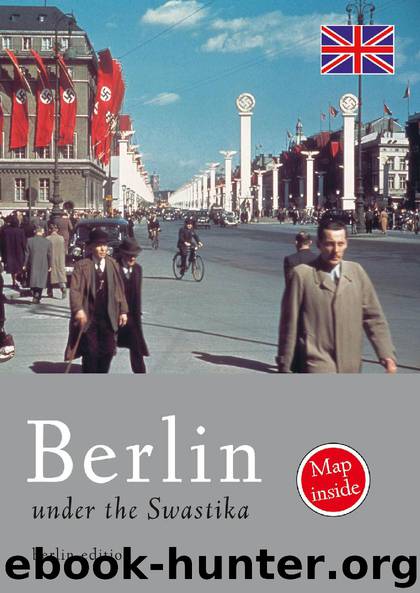
Berlin by Sven Felix Kellerhoff
Author:Sven Felix Kellerhoff
Language: deu
Format: epub
Publisher: be.bra verlag
Published: 2014-11-15T00:00:00+00:00
Megalomaniac visions
The plans for turning Berlin into the “World Capital Germania”, designed by Albert Speer, were an intrinsic part of National Socialistic rule, but many myths have grown up around these utterly megalomaniac visions. For example, Hitler did not initially get involved in city planning through any initiative of his own, but because he was asked by the Mayor of Berlin to make a specific decision about the exact route of the underground S-Bahn line between Potsdamer Platz and Friedrichstrasse stations. Hitler used this opportunity to demand plans from the city authorities for the new lay-out of the German capital. Their employees accordingly drew up designs for a Nord-Süd-Achse (North-South-Axis) between Spreebogen and Tempelhofer Feld (today, Tempelhof Airport), thereby revisiting the ideas on restructuring the west end of Berlin, which had been under constant discussion for over a century. In addition, a large Ost-West-Achse (East-West-Axis) was to be created, which would link Charlottenburg with Mitte. The first design met with Hitler’s basic approval but was considered too modest. He wanted a “huge triumphal arch for the undefeated army of the World War” and a “really large assembly hall capable of holding 250,000 people.” However, the planning did not make much progress because the thinking of the architects working for the city authorities was much more restrained (realistic) than that of the “Führer”. It wasn’t until 1936 that Hitler finally made up his mind to entrust Albert Speer, who was at the time only just 31 years old, with this “largest of all” building contracts. In the meantime his wishes had grown to completely grotesque proportions and the North-South-Axis now had to be 120 metres wide. Over the next few years Speer increased the dimensions further; if one compares the first plans for the Nord-Süd-Achse made in his office in 1936 with the last ones made in 1942 the ever increasing proportions are quite clear. Most of Speer’s designs were architecturally banal, consisting mainly of gigantic enlargements of the buildings already created in the thirties. Most of the ground plans were characterised by impractically large halls; the width alone of the Nord-Süd-Achse would have created an intimidating effect. The “Grosse Halle” (Great Hall), the most colossal of all the plans, was supposed to have a 250 metre wide dome and reach an overall height of 290 metres. Perhaps with today’s technology and unlimited resources such a building could be constructed, but in Speer’s times it was technically out of the question. All the quarries in Europe would not have had enough stone for the façades of the buildings planned to line the Nord-Süd-Achse. To solve this problem Himmler and Speer agreed that KZ prisoners should be made to work in brick factories and quarries – proof of the fact that Speer, who successfully promoted himself as a “good Nazi” after 1945, was heavily involved in the crimes of the Third Reich.
Only few of Speer’s plans were ever completed and fewer still can be seen today; essentially only the East-West-Axis, the route
Download
This site does not store any files on its server. We only index and link to content provided by other sites. Please contact the content providers to delete copyright contents if any and email us, we'll remove relevant links or contents immediately.
| Africa | Americas |
| Arctic & Antarctica | Asia |
| Australia & Oceania | Europe |
| Middle East | Russia |
| United States | World |
| Ancient Civilizations | Military |
| Historical Study & Educational Resources |
Room 212 by Kate Stewart(5119)
The Crown by Robert Lacey(4814)
Endurance: Shackleton's Incredible Voyage by Alfred Lansing(4780)
The Iron Duke by The Iron Duke(4354)
The Rape of Nanking by Iris Chang(4211)
Joan of Arc by Mary Gordon(4109)
Killing England by Bill O'Reilly(4001)
Say Nothing by Patrick Radden Keefe(3984)
I'll Give You the Sun by Jandy Nelson(3446)
Shadow of Night by Deborah Harkness(3367)
Hitler's Monsters by Eric Kurlander(3341)
Mary, Queen of Scots, and the Murder of Lord Darnley by Alison Weir(3210)
Blood and Sand by Alex Von Tunzelmann(3203)
Eleanor & Park by Rainbow Rowell(3171)
Darkest Hour by Anthony McCarten(3129)
Margaret Thatcher: The Autobiography by Thatcher Margaret(3081)
Book of Life by Deborah Harkness(2938)
Red Famine: Stalin's War on Ukraine by Anne Applebaum(2932)
The One Memory of Flora Banks by Emily Barr(2863)
